
For egg producers and packers, pallet wrapping is more than a final handling step. The right egg pallet wrap must secure the load while also working with the conditions eggs and cartons experience after washing. When cooling and drying are insufficient, moisture can remain a concern around the wrapped pallet, contributing to operational problems such as egg spoilage and carton damage.
That is the challenge behind the search for ventilated stretch film for eggs. Rather than treating wrapping as an isolated packaging decision, operations managers can look at how the wrap affects air circulation and moisture release during the period after washed eggs are prepared for pallet movement. The Arkansas Eggs case study, supplied as the source for this article, shows how BreatheWrap vented stretch film was used to address that concern.
This article explains the egg pallet wrapping challenge, why regular stretch film can limit cooling and drying, how ventilated pallet wrap supports air flow, and what the Arkansas Eggs operation reported after moving to vented film. The results described are case-study outcomes, not universal guarantees.
| Key takeaway: The Arkansas Eggs case study reports that BreatheWrap immediately improved air circulation and moisture release, with reported elimination of mold and mildew and a reduction in spoilage and carton damage. |
The Egg Pallet Wrapping Challenge
Egg pallets need to be secured for handling and movement, which makes stretch film an important part of the packaging process. For the egg industry, however, the wrapping decision also intersects with what happens after eggs are washed. Cooling and drying washed eggs can be affected by the conditions around the pallet, including how easily air can circulate and how readily moisture can be released.
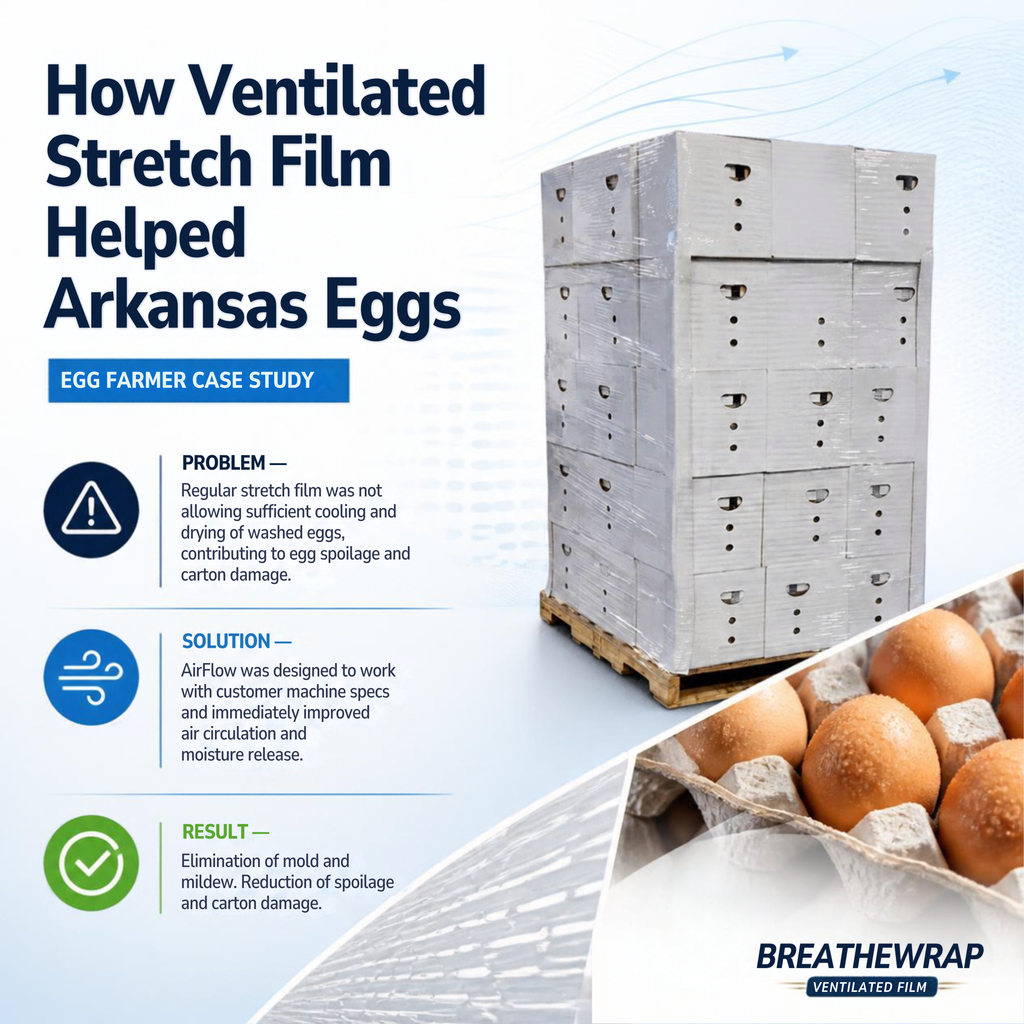
The supplied case study identifies a large egg farming operation, Arkansas Eggs, that was using regular stretch film to secure egg pallets. In that operation, insufficient cooling and drying of washed eggs contributed to spoilage and carton damage. The issue was not simply whether the pallets were wrapped; it was whether the chosen stretch film supported the post-wash conditions the operation needed.
Why Regular Stretch Film Can Limit Cooling and Drying
Regular stretch film is used to hold a pallet load together. When it forms a continuous wrap around a load, the wrapped area may have less opportunity for air circulation and moisture release than the operation requires. In practical terms, restricted air flow can make it more difficult for heat and moisture around washed eggs and cartons to move away from the pallet.
That distinction matters because washed eggs enter the pallet-wrapping stage with drying and cooling still relevant to the condition of the load. If the wrapped environment does not allow sufficient movement of air or release of moisture, the consequences described in the Arkansas Eggs case study can include spoilage and carton damage. Mold and mildew are also important concerns in the reported outcome.
The following summary shows how the challenge connects the wrapping material to the post-wash process:
| Operational point | Why it matters | Case-study connection |
| Washed eggs need cooling and drying | Air circulation and moisture release are relevant to the condition of the wrapped pallet. | Insufficient cooling and drying contributed to spoilage and carton damage. |
| Regular stretch film secures the pallet | A continuous wrap can limit the movement of air and moisture around the load. | Arkansas Eggs was using regular stretch film when the reported problems occurred. |
| Cartons remain part of the wrapped load | Carton condition can be affected when moisture is not released effectively. | The case study reported carton damage alongside spoilage. |
How Ventilated Stretch Film for Eggs Supports Air Circulation and Moisture Release
Ventilated pallet wrap is intended to create a wrapping approach that better supports air circulation around the secured load. For washed eggs, that means giving air more opportunity to move through the pallet area while allowing moisture to release rather than remain concentrated around the eggs and cartons.
The basic principle is straightforward: a pallet can be secured while the wrapping design also addresses the need for air flow. This does not change the importance of correct pallet handling or machine application. It adds another consideration for operations evaluating stretch film for the egg industry: whether the wrap supports the cooling and drying conditions required after washing.
For producers, packers, and operations managers, the potential value of ventilated stretch film for eggs is therefore connected to the full workflow. The relevant questions are not limited to whether the film holds the pallet together. They also include whether the wrapping approach supports:
- Air circulation around the wrapped egg pallet after washing.
- Moisture release from the area surrounding eggs and cartons.
- Cooling and drying during the post-wash stage described in the case study.
- Operational fit with the customer machine specifications used to apply the wrap.
This is why a ventilated pallet wrap solution should be considered in the context of the equipment and process already in place. A useful solution must address the airflow and moisture challenge while also being designed around the customer’s machine specifications, rather than treated as a disconnected packaging change.
| Important distinction: Better airflow and moisture release can be relevant to the problems described in the case study, but the reported Arkansas Eggs outcome should not be read as a guarantee that every egg operation will achieve identical results. |
Arkansas Eggs: A Case Study in Changing the Wrap
The supplied case study centers on Arkansas Eggs, a large egg farming operation that was using regular stretch film to secure egg pallets. According to the case study, insufficient cooling and drying of washed eggs contributed to spoilage and carton damage. The operation needed a wrapping approach that addressed more than pallet security alone.
The Air Flow Solution: Ventilated Stretch Film for Eggs
BreatheWrap vented film was designed to work with the customer machine specifications. This compatibility was an important part of the solution because the wrap needed to fit the way the customer’s operation applied stretch film. According to the case study, BreatheWrap immediately improved air circulation and moisture release after it was introduced.
The case study reports two connected outcomes: elimination of mold and mildew, and a reduction in spoilage and carton damage. These are the specific results reported for Arkansas Eggs. They provide a practical example of why egg producers and packers may evaluate ventilated stretch film as part of a broader cooling, drying, and pallet-wrapping review.
| Case-study element | Reported information |
| Operation | Arkansas Eggs, identified as a large egg farming operation. |
| Previous approach | Regular stretch film was used to secure egg pallets. |
| Challenge | Insufficient cooling and drying of washed eggs contributed to spoilage and carton damage. |
| Solution | BreatheWrap was designed to work with the customer machine specifications. |
| Immediate change | The case study reports improved air circulation and moisture release. |
| Reported result | Elimination of mold and mildew, with reduced spoilage and carton damage. |
Operational Benefits Described in the Case Study
The reported benefits are closely tied to the original problem. Improved air circulation and moisture release addressed the conditions associated with insufficient cooling and drying. The reported elimination of mold and mildew addressed a visible quality concern, while the reduction in spoilage and carton damage addressed the operational consequences identified at the start of the case study.
For an operations manager, the lesson is not that one film automatically solves every packaging issue. The lesson is that the choice of egg pallet wrap can be evaluated against the actual needs of the post-wash process, the condition of cartons, and the specifications of the customer’s machine.
What This Means for Egg Producers and Packers
The Arkansas Eggs case study gives egg operations a clear point of reference when reviewing their current stretch film. If washed eggs are not cooling or drying as needed, it may be useful to examine how the existing wrap affects air circulation and moisture release around the pallet. That review should include the wrapping process and the customer machine specifications used to apply the film.
When evaluating ventilated stretch film for eggs, operations can organize the discussion around a few practical questions:
- Post-wash conditions — Are cooling and drying of washed eggs being considered alongside pallet security?
- Air movement — Does the current egg pallet wrap support the air circulation the operation needs?
- Moisture — Is moisture release part of the conversation when reviewing spoilage, carton damage, mold, or mildew concerns?
- Machine fit — Can the proposed ventilated pallet wrap work with the customer machine specifications?
These questions do not replace an operation-specific assessment. They help producers, packers, and operations managers connect the material choice to the process issue described in the case study without assuming that every facility will have the same conditions or outcome.
Conclusion: A More Considered Approach to Egg Pallet Wrap
For the egg industry, stretch film is part of a larger process that includes washing, cooling, drying, palletizing, and handling. Regular stretch film may not provide the air circulation and moisture release needed in every application. The Arkansas Eggs case study shows how insufficient cooling and drying contributed to spoilage and carton damage, and how BreatheWrap vented film was used to address that challenge.
The reported outcome was immediate improvement in air circulation and moisture release, along with elimination of mold and mildew and a reduction in spoilage and carton damage. Those results belong to the Arkansas Eggs case study and should not be treated as universal guarantees. Still, they offer a useful reason to consider whether ventilated stretch film for eggs could be relevant to your own operation.
If you are reviewing egg pallet wrap or looking for stretch film for the egg industry that is designed around customer machine specifications, contact BreatheWrap to discuss conditions your operation is working to improve.
FAQ: Ventilated Stretch Film for Eggs
What is ventilated stretch film for eggs?
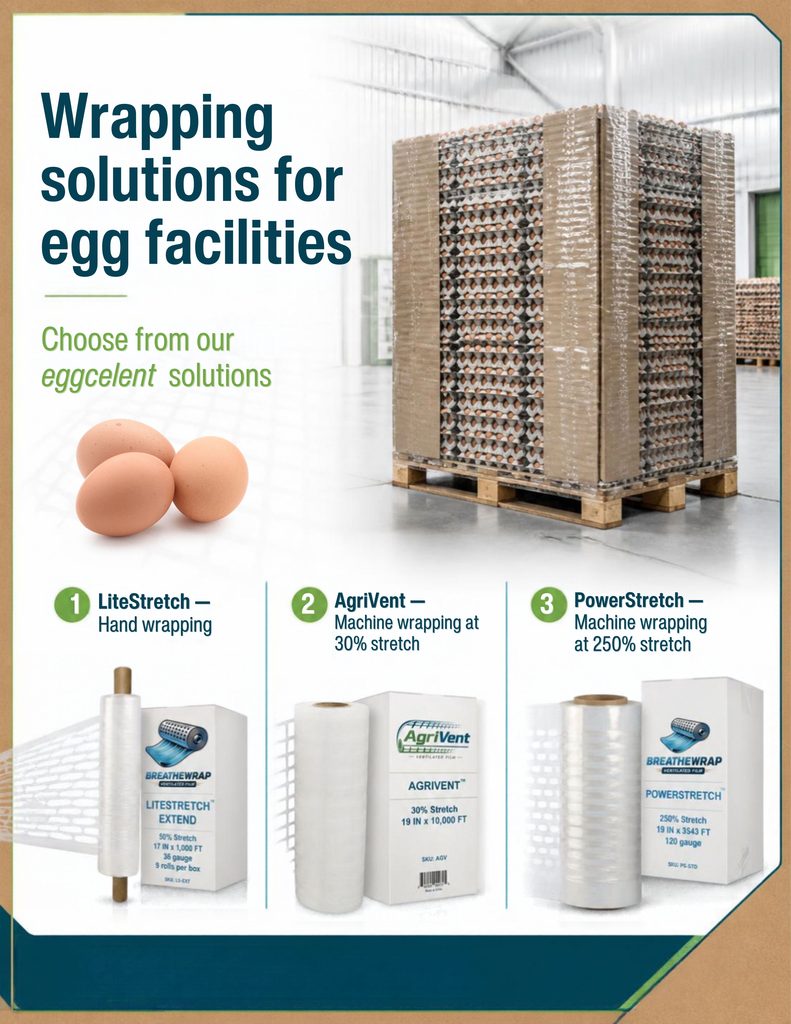
In this article, ventilated stretch film refers to a pallet-wrapping approach intended to support air circulation and moisture release around secured egg pallets. PowerStretch is the BreatheWrap solution named in the supplied Arkansas Eggs case study.
Why can regular stretch film limit cooling and drying after eggs are washed?
When regular stretch film forms a continuous wrap around a pallet, the wrapped area can have less opportunity for air circulation and moisture release. In the Arkansas Eggs case study, insufficient cooling and drying of washed eggs contributed to spoilage and carton damage.
Was BreatheWrap compatible with the customer’s equipment?
The case study states that BreatheWrap was designed to work with the customer machine specifications. It also reports that the solution immediately improved air circulation and moisture release.
What results did Arkansas Eggs report?
The reported results were elimination of mold and mildew, along with a reduction in spoilage and carton damage. These outcomes are specific to the case study provided.
Does the case study guarantee the same result for every operation?
No. The Arkansas Eggs results are reported case-study outcomes, not universal guarantees. Conditions can differ between egg operations, so ventilated pallet wrap should be evaluated in the context of the facility’s process and customer machine specifications./