
A Better Way to Wrap Plant Carts: Manual, Semi-Automatic, and High-Stretch Vented Film Solutions
How LiteStretch, AgriVent, and PowerStretch help horticultural operations balance speed, plant protection, airflow, and load security
Vented Stretch Film for Plant Carts: Choosing the Right BreatheWrap Soluti
Wrapping a cart filled with live plants is more complex than securing an ordinary pallet. Flowers, foliage, shrubs, seedlings, and nursery stock remain living products after they leave the growing area. They may need to be watered, staged, loaded, inspected, and transported while staying stable on the cart.
The cart may need to remain stationary during wrapping because it cannot safely rotate. Movement or centrifugal force can disturb plants, shift containers, or create unnecessary handling risk. At the same time, a tightly contained load still needs an approach that considers air movement, moisture dissipation, temperature, visibility, and the condition of the crop.
There is no single correct wrapping method for every horticultural operation. The right choice depends on cart design, crop type and sensitivity, wrapping method, staffing, throughput, route conditions, staging practices, and available equipment. A controlled evaluation can help an operation compare manual, semi-automatic, and high-stretch options against its own requirements.
| Key takeawayBreatheWrap offers a progression from quick manual wrapping to semi-automatic wrapping and high-stretch machine applications. Vented film can help operations consider airflow and moisture management alongside containment, but every solution should be assessed for the specific crop, cart, route, and process. |
GOALS
| Protect plants in transit Keep the load contained while reducing avoidable movement, contact, and handling during staging and transport. | Improve airflow and moisture management Review whether the wrapping approach supports appropriate air movement, moisture dissipation, and crop visibility. | Fit the wrapping method to the operation Match manual, semi-automatic, or high-stretch machine application to the cart, team, equipment, and workflow. | Reduce avoidable handling time and material waste Use trial measurements to identify opportunities without assuming a guaranteed labour, throughput, or cost result. |
CHALLENGE
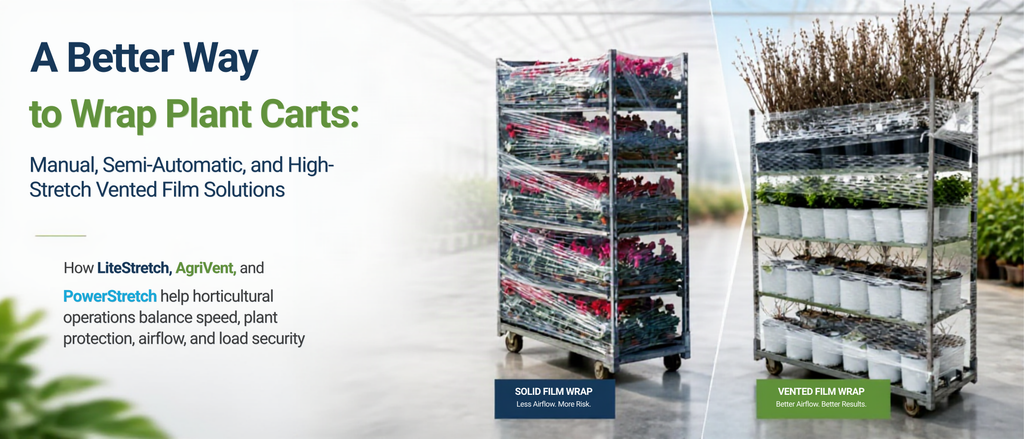
Conventional solid stretch film can create a difficult trade-off around plant carts. It may help contain the load, but it can also reduce airflow around plants and may hold heat or moisture around the load depending on crop condition, ambient temperature, watering status, wrap tightness, and the duration of staging or transport.
The risk becomes more difficult to manage when the cart cannot rotate. An operator may need to walk around a fixed cart, reach between shelves, and apply film consistently without brushing against delicate stems, flowers, foliage, or containers. Manual wrapping can be labour-intensive, and application quality may vary from one operator or cart to the next.
A machine-based solution may offer greater repeatability, but horticultural carts do not always present a standard pallet footprint. Shelves, wheels, handles, uneven loads, and changing crop heights can affect the wrap pattern and the machine settings. Equipment compatibility therefore needs to be confirmed rather than assumed.
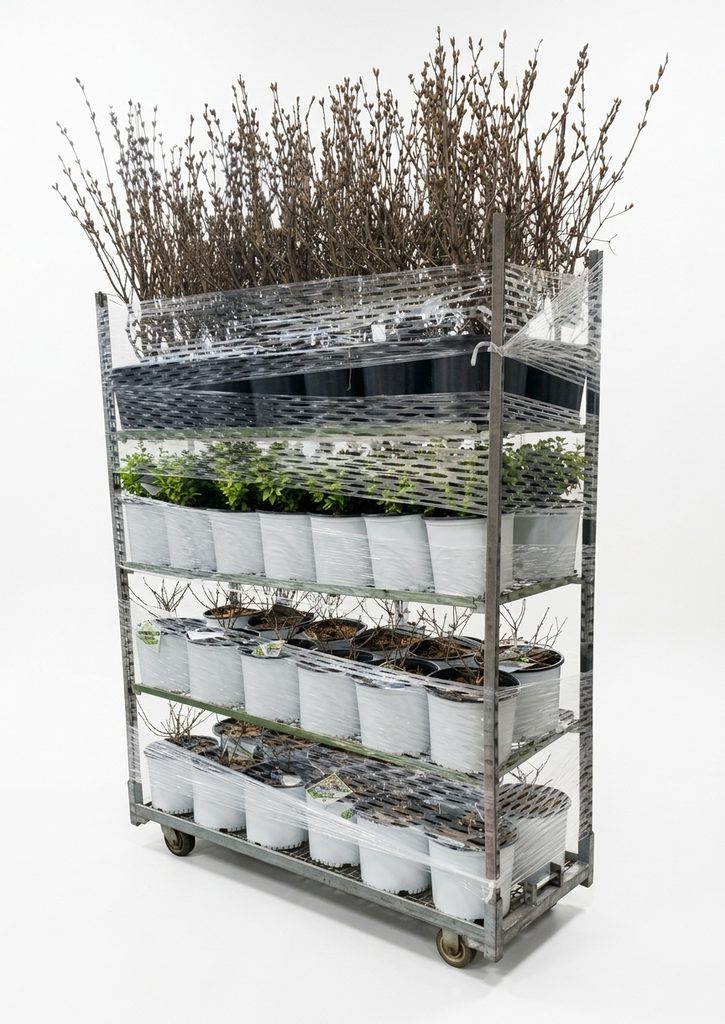
| Photo frame: illustrative cart comparisonInsert supplied cart photo here: Cart wrapped in solid film: use as an illustrative example of restricted airflow risk.Solid film: limited airflow can put plants at risk. | Photo frame: illustrative cart comparisonInsert supplied cart photo here: Cart wrapped in vented film: use as an illustrative example of increased air movement.Vented film: supports airflow and moisture dissipation. |
Important: The supplied cart photos are illustrative examples, not a controlled customer test. They should not be used alone to establish plant outcomes, airflow performance, damage rates, or material savings.
PROCESS
- Observe the current wrapping method, including how operators move around the cart, where film is started and finished, and which parts of the load are most difficult to secure.
- Measure or document cart dimensions, shelf spacing, wheel position, load height, crop density, container sizes, and any irregular or overhanging areas.
- Identify whether the cart can rotate safely. If it cannot, document the available working space and the operator movements required for a complete wrap.
- Review watering, staging, dock, vehicle, and route conditions, including time between wrapping and unloading and exposure to heat, cold, wind, or changing humidity.
- Determine the desired throughput, available labour, operator experience, and whether semi-automatic or high-stretch equipment is already present or being considered.
- Test solid versus vented film under controlled operating conditions, using comparable carts, crops, wrap patterns, and observation periods wherever practical.
- Confirm equipment compatibility and application settings before relying on a machine-based process for routine production.
SOLUTION
BreatheWrap provides three options for operations evaluating different levels of manual effort, machine involvement, stretch, and ventilation. The products should be matched to the actual cart and crop through an application review and trial rather than selected from product specifications alone.
BreatheWrap LiteStretch: quick manual wrapping
LiteStretch is intended for fast, practical hand application when carts need to be wrapped without a full machine installation. It may suit smaller volumes, flexible workflows, or locations where operators need to wrap carts directly at the growing, staging, or loading area.
The supplied product image shows LiteStretch Extend with package information of 50% stretch, 17 in x 1,000 ft, 63 gauge, and 9 rolls per box. These details are presented as information shown on the supplied package image, not as a performance guarantee for a particular crop, cart, operator, or route.
| Photo frame: BreatheWrap LiteStretchInsert or position the supplied LiteStretch Extend product image here. |
| PHOTO FRAME — BreatheWrap LiteStretch |
AgriVent: vented film for semi-automatic wrapping
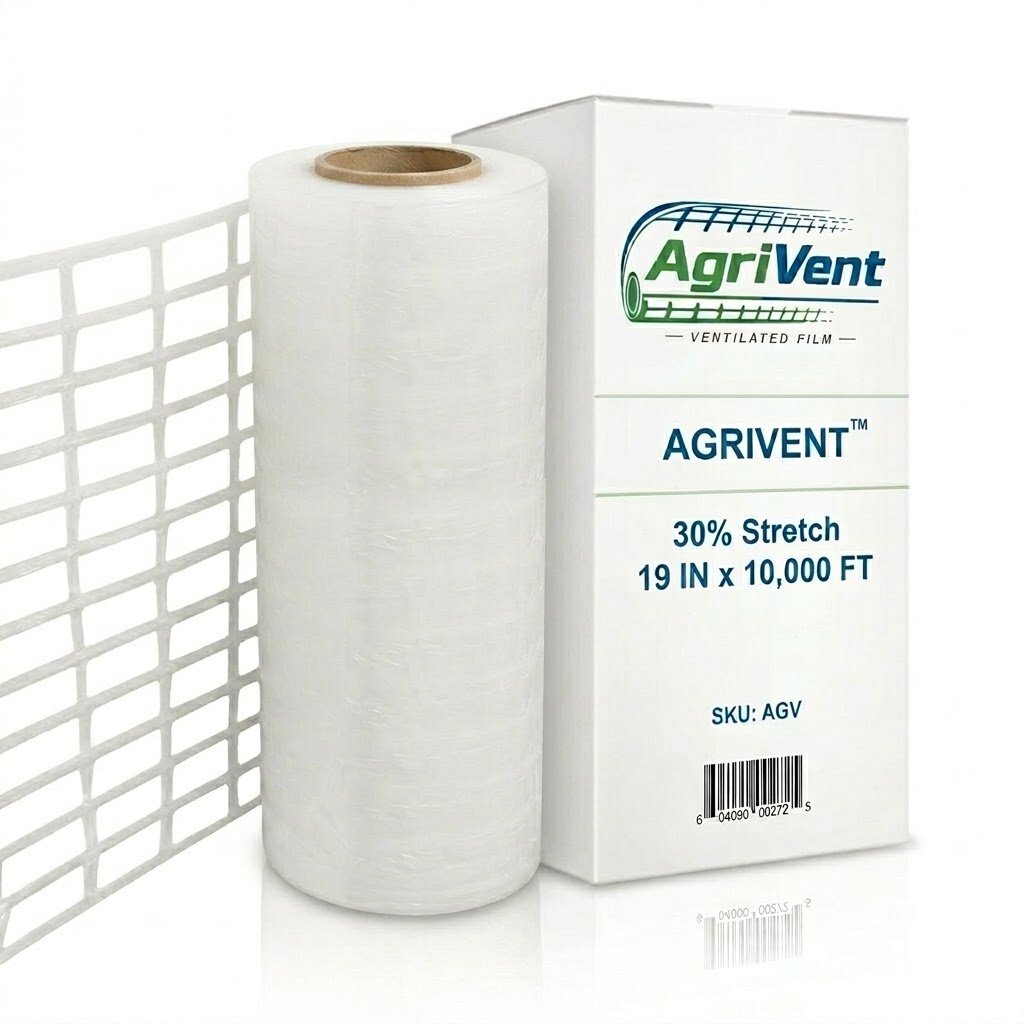
AgriVent is suited to operations evaluating semi-automatic machine application and wanting a vented film option for plant carts or other horticultural loads. It can be considered where the team is moving toward a more repeatable wrapping process while still needing to account for unusual cart footprints and changing crop profiles.
The supplied product image shows 30% stretch and 19 in x 10,000 ft. Actual compatibility depends on the machine, cart dimensions, wrap pattern, application settings, crop condition, and trial results. The package information should therefore be treated as a starting point for evaluation, not a promise of a particular outcome.
| Photo frame: AgriVentInsert or position the supplied AgriVent product image here. |
| PHOTO FRAME — AgriVent |
BreatheWrap PowerStretch: 250% stretch for high-stretch applications
PowerStretch is intended for operations evaluating high-stretch machine wrapping where material yield, containment, and repeatability are important considerations. It may be relevant to higher-volume workflows, but the correct pre-stretch and wrap settings still need to be established for the cart, crop, and equipment.
The supplied product image shows 250% stretch, 19 in x 3,543 ft, and 120 gauge. These are package details visible in the supplied image. They should not be interpreted as a promise of a specific reduction in film usage, labour, cost, crop loss, or handling time.
| Photo frame: BreatheWrap PowerStretchInsert or position the supplied PowerStretch product image here. |
| PHOTO FRAME — BreatheWrap PowerStretch |
Solution comparison
| Solution | Wrapping method | Best suited for evaluating | Key consideration |
| LiteStretch | Quick manual wrapping | Smaller volumes, flexible workflows, or carts needing immediate hand application | Consistency depends on the operator and application technique. |
| AgriVent | Semi-automatic machine wrapping | Operations moving toward repeatable machine wrapping with ventilation | Confirm machine compatibility, cart dimensions, wrap pattern, and settings. |
| PowerStretch | High-stretch machine wrapping | Higher-volume or repeatable machine applications where 250% stretch is relevant | Validate containment, pre-stretch settings, film yield, and crop condition in a trial. |
Innovative and Reliable Packaging for Every Need
Our expertise ensures top-notch quality in every product we deliver.

PowerStretch 250%
20″ x 3543 for Machine with Pre-Stretch Rollers

LiteStretch Extended
17″ x 1000′ for quick manual application

LiteStretch Standard
17″ x 1550′ for a little more length on the roll
AgriVent 30%
19″ x 11,500′ for semi-auto machine wrapping
Why Vented Film Matters for Plants and Flowers
Living plants continue exchanging air and moisture after they are wrapped. A vented film can help allow more air movement through the load and may support moisture dissipation compared with a solid film approach, depending on the film design, wrap pattern, crop density, and environmental conditions.
That airflow may be relevant when carts are watered after wrapping, staged before dispatch, or moved through areas with changing temperatures. Vented film may also support heat management, reduce the extent to which moisture is held around the load, and make it easier to observe plant condition through the wrap. These benefits should be evaluated in the actual process rather than assumed for every crop or route.
Ventilation does not replace correct crop care, irrigation, temperature control, packaging, load stability, or safe transport. A crop may still be damaged by unsuitable watering, excessive heat, cold exposure, impact, vibration, poor container stability, or an inappropriate wrap pattern.
Solid Film vs. Vented Film: What to Review
| Review area | Questions to ask |
| Air movement | Does the film and wrap pattern allow enough air movement for the crop, cart density, staging time, and route? |
| Moisture and watering | Will the cart be watered after wrapping, and where will excess moisture go? |
| Heat and condensation | Could the wrap hold heat or moisture around the load under the expected environmental conditions? |
| Plant condition | How will operators inspect foliage, flowers, stems, and containers before loading and after transport? |
| Cart stability | Does the wrap contain the load without pressing against delicate plants or shifting containers? |
| Wrap method | Can operators apply the film consistently by hand, or would semi-automatic or machine wrapping improve repeatability? |
| Machine compatibility | Can the equipment accommodate the cart footprint, shelves, wheels, handles, load height, and chosen film? |
| Route or staging conditions | How long will the cart remain wrapped, and what temperatures, humidity, wind, loading, and unloading conditions will it encounter? |
Note: The two supplied cart photos are illustrative and should not be treated as a controlled test or proof of comparative plant performance.
Choosing the Right Wrap for Your Operation
Choose LiteStretch when the immediate need is quick manual wrapping, the volume is smaller or variable, and operators need flexibility without a full machine installation. The evaluation should focus on application consistency, operator reach, cart stability, and film used per cart.
Choose AgriVent when the operation is considering semi-automatic machine wrapping and wants to evaluate ventilation alongside a more repeatable process. Review machine compatibility, cart dimensions, wrap pattern, settings, staffing, and the transition between growing, staging, and loading areas.
Choose PowerStretch when high-stretch machine wrapping is being evaluated for a higher-volume or repeatable application and the supplied 250% stretch specification is relevant to the equipment and process. Validate containment, pre-stretch settings, film yield, crop condition, and handling results before drawing conclusions about material or cost benefits.
Across all three options, consider current volume, manual labour, available equipment, desired repeatability, cart dimensions, crop sensitivity, route conditions, and material-use goals. A representative trial is the right way to compare options because the result depends on the complete system, not the film alone.
RESULTS AND EVALUATION
Because every horticultural operation uses different carts, crops, routes, and handling practices, results should be measured rather than assumed. A useful trial compares comparable loads and records both process measures and crop observations over the relevant staging and transport period.
- Wrapping time per cart — Record the time needed to complete a consistent wrap, including setup and film changes.
- Operators required — Note whether the process needs one operator, multiple operators, or machine assistance.
- Film used per cart — Track material consumption without assuming that a longer roll or higher stretch automatically produces a saving.
- Cart stability — Observe movement, container shift, plant contact, and load security during staging, loading, transport, and unloading.
- Plant condition — Check foliage, flowers, stems, containers, and overall crop condition after staging and transport.
- Airflow and moisture — Record practical observations about air movement, moisture dissipation, condensation, and heat around the load.
- Watering workflow — Document whether watering after wrapping is possible, controlled, and appropriate for the crop and route.
- Damage or breakage — Record visible damage, abrasion, breakage, tipping, or other handling issues using the same observation method across trials.
- Loading and unloading — Assess access, visibility, operator effort, and whether the wrap needs to be removed or adjusted at each handoff.
| The correct result is operation-specific.Measure the conditions that matter to your crop, cart, route, and team. |
CONCLUSION
A More Considered Way to Wrap Plant Carts
Solid film can provide containment, but it may restrict airflow and may hold heat or moisture around living plants under some conditions. Vented film is designed to allow more air movement and moisture dissipation while helping secure the cart. Neither approach should be treated as a universal answer without considering crop care, cart stability, environmental exposure, and transport conditions.
For quick manual wrapping, BreatheWrap LiteStretch can be evaluated where flexible hand application is the priority. For operations moving toward semi-automatic wrapping, AgriVent provides a vented film option to assess with the machine, cart, and wrap pattern. For high-stretch machine applications, BreatheWrap PowerStretch includes a supplied package specification of 250% stretch and should be evaluated for containment, repeatability, film yield, and crop condition.
Review your carts, wrapping method, equipment, route, and crop requirements with a qualified packaging specialist. A practical trial can help your team compare the options using the measures that matter most to your operation.
FAQ: BreatheWrap Vented Film for Plant Carts
Can vented film replace solid stretch film for every plant cart?
No. Vented film may be a better fit for some crops, carts, watering workflows, and routes, but it does not replace the need to evaluate crop sensitivity, containment, temperature, moisture, equipment, and transport conditions for each application.
Which BreatheWrap product is best for quick manual wrapping?
BreatheWrap LiteStretch is the option intended for quick manual wrapping. The supplied product image shows LiteStretch Extend with 50% stretch, 17 in x 1,000 ft, 63 gauge, and 9 rolls per box. These package details do not guarantee a particular result in every operation.
What is AgriVent intended for?
AgriVent is intended for operations evaluating semi-automatic machine wrapping with a vented film option. The supplied product image shows 30% stretch and 19 in x 10,000 ft. Machine compatibility and application results should be confirmed through equipment checks and trials.
What does 250% stretch mean for PowerStretch?
The supplied PowerStretch product image identifies 250% stretch. In practice, the useful result depends on the machine, pre-stretch settings, wrap pattern, cart, crop, and containment requirements. It should not be treated as a promise of a specific material saving or outcome.
Can plants be watered after wrapping?
Possibly, depending on the crop, film, wrap pattern, watering method, drainage, staging conditions, and safety requirements. The watering workflow should be tested and confirmed for the specific operation rather than assumed from the use of vented film alone.
Will vented film prevent plant damage?
No film can be assumed to prevent all plant damage. Vented film can help with airflow and moisture management, but damage may still result from heat, cold, impact, vibration, poor load stability, unsuitable watering, or handling conditions.
Can these films work with existing equipment?
They may, but compatibility depends on the machine, film dimensions, cart footprint, wrap pattern, settings, and operating method. Equipment checks and application trials are important before adopting a film for routine production.